Sereact and Nebius Partner to Accelerate the Learning Loop for Enterprise Robots, powered by NVIDIA
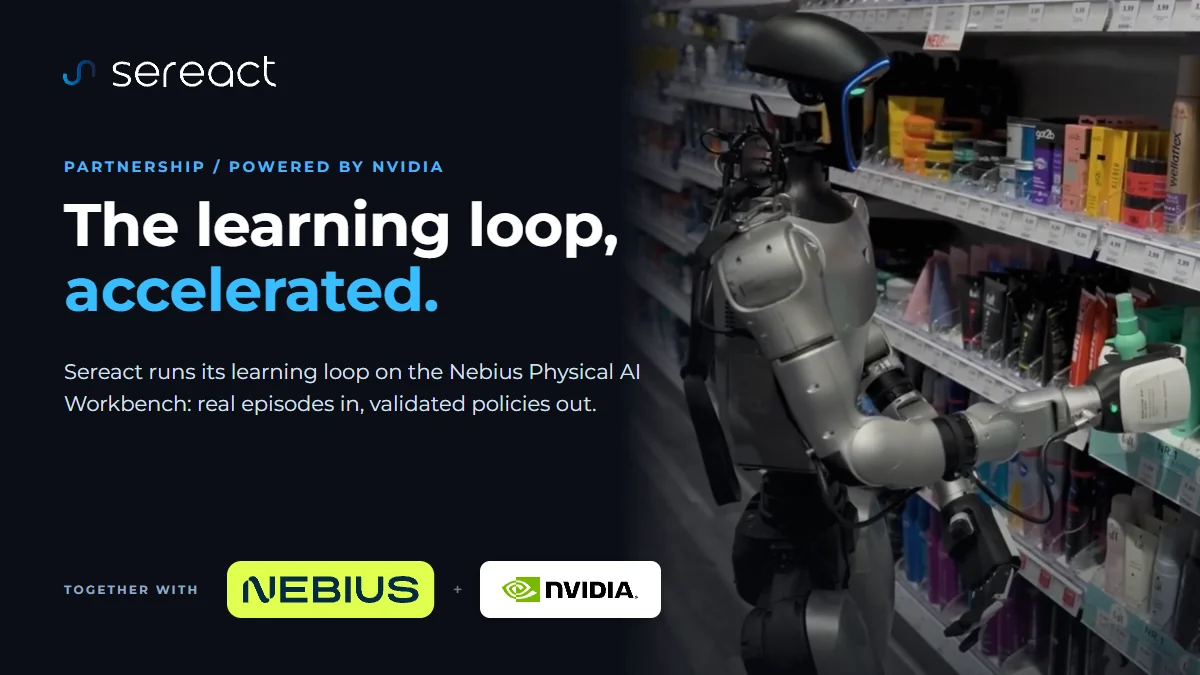
The partnership puts Sereact's data flywheel - real episodes in, validated policies out - on the Nebius Physical AI Workbench. The first joint workflow is a closed-loop sim-to-real pipeline that AI agents build and run using NVIDIA Isaac, NVIDIA Cosmos, and NVIDIA Cosmos Data Factory, deployed first for Sereact robots replenishing shelves in stores.
Sereact, the embodied-AI company behind the Cortex robot brain, and Nebius, the AI infrastructure company, today announced a partnership to shorten the loop by which robots working in enterprise sites get better. Sereact will run its learning loop - collect, simulate, train, evaluate, deploy - on the Nebius Physical AI Workbench, so that what a robot learns at one customer site reaches the next site in days rather than weeks. The first joint pipeline is live: a closed-loop sim-to-real workflow that AI agents assemble and operate, used first for Sereact robots replenishing shelves in stores.
A robot fleet improves only as fast as its slowest loop. Sereact's Cortex model learns from real picks, but turning a failure on a customer's floor into a better policy on the robot still had to run through the physical world. This involved collecting episodes on site, retraining, testing on the robot, and repeating. Each cycle took weeks and covered only the scenarios a team could stage by hand. Where a replenishment robot handles thousands of SKUs across fixtures, packaging, and lighting that differ from store to store, every new store is a new set of unseen conditions, and the store floor is not a test lab. Simulation could cover those conditions, but standing up NVIDIA Isaac Sim, NVIDIA Cosmos, training clusters, and evaluation environments on cloud GPUs, and then wiring them all together, was a heavy infrastructure project, not a robotics one.
On the Nebius Physical AI Workbench, the loop is one workflow on one shared data layer. Real episodes - video plus kinematics - land in a single Nebius object storage bucket. From there the pipeline runs seven steps: ingest; simulate and augment (Isaac Lab generates 10,000 environment variants and Cosmos re-renders them across lighting, fixture, and packaging conditions); version the dataset with an 80/20 split; train the policy on 8,000 environments; evaluate on 2,000 held-out environments with a VLM-scored rubric; check the score against a threshold; and, on pass, deploy to the store robot for a real-world test. On failure, the pipeline generates targeted augmentation for the scenarios that missed, retrains, and re-evaluates. The result is a replenishment robot that arrives at a new store already validated against thousands of variants of that store's conditions.
What is new is who builds and runs the pipeline. Instead of engineers hand-wiring five tools, an AI agent assembles the workflow from skills. NVIDIA Cosmos Data Factory blueprint skills are open, versioned instruction files a coding agent reads directly; each owns flow selection, credential and GPU-pool preflight, model-cache checks, submission, monitoring, and output retrieval. Nebius adds Workbench skills for large-scale simulation, training, evaluation, and the gate. The agent then orchestrates the run: it previews runtime and GPU cost before anything starts, launches each stage, checks the gate, and when a run fails, decides which scenarios to augment, reruns, and reports the delta. Engineers describe the outcome - "validate the replenishment policy for the new shelf fixtures" - and approve decisions above a cost threshold. The agent does the rest.
- Sereact brings Cortex, its vision-language-action model; real episodes from its fleet; and its enterprise deployments.
- Nebius brings the Physical AI Workbench - CLI, SDK, shared object storage, and format contracts at every handoff - and the GPUs behind it: RTX-class for simulation and augmentation, Blackwell for training, in EU data centers.
- NVIDIA brings Cosmos, Isaac Sim and Isaac Lab, and the Cosmos Data Factory blueprint skills that make the pipeline agent-operable.
"A robot fleet is a learning system, and today most of that system runs on tired engineers," said Evan Helda, Head of Physical AI at Nebius. "Sereact already has the hardest part - a billion real picks and customers who trust the robots. What we bring is the loop: real episodes go in, a gated policy comes out, and an agent runs the steps in between. Starting with store replenishment is deliberate. Thousands of SKUs, hundreds of stores, no two aisles alike."
"Cortex improved by learning from real picks, and that won't change. What this partnership adds is coverage and speed: the store we haven't opened yet, the fixture that ships next quarter, the lighting at closing time, tested against ten thousand variations," said Ralf Gulde, CEO of Sereact.
The closed-loop sim-to-real pipeline is available today as a Workbench reference architecture, with the NVIDIA Cosmos Data Factory blueprint skills pre-installed, for any robotics team on Nebius. It runs in Nebius EU regions; customers pay for the compute and storage they use, with no separate Workbench fee. Robotics teams can request a design-partner slot through a Nebius account team.
About Sereact
Sereact builds physical AI for warehouses and manufacturing. Its Cortex brain runs across single-arm picking cells, dual-arm returns stations, humanoid robots, and Sereact Lens, a 3D perception system for inventory and quality control. Founded in 2021, headquartered in Stuttgart. Customers include IKEA, Arvato, alza.cz, Flaschenpost, Sonepar, Monta part of DHL, Daimler Truck, Mercedes-Benz, BMW, MS Direct, Paxon part of Bnode, DeltiLog, Rohlik Group, and Austrian Post. With Zalando's participation, Sereact has now raised over $145 million to date.
About NVIDIA
NVIDIA (NASDAQ: NVDA) is the pioneer of accelerated computing and a driving force behind the modern AI era, providing the platforms used across industries from cloud computing to robotics. Through its Isaac platform, NVIDIA supports robotics developers with simulation, training, and deployment tools - including NVIDIA Isaac Sim, which enables companies like Sereact to develop and validate robots in physically accurate virtual environments before deploying them in real-world operations.
About Nebius
Nebius, the AI cloud company, is building the full-stack platform for developers and companies to take charge of their AI future - from data and model training to production deployment. Founded on deep in-house technological expertise and operating at scale with a rapidly expanding global footprint, Nebius serves startups and enterprises building AI products, agents and services worldwide. Nebius is listed on Nasdaq (NASDAQ: NBIS) and headquartered in Amsterdam.
Article Resources
Access content and assets from this post
Text Content
Copy the full article text to clipboard for easy reading or sharing.
Visual Assets
Download all high-resolution images used in this article as a ZIP file.
Latest Articles