Automated Returns
Handling.
One station. Every return. No manual sorting.
Returns are high-volume, high-variability, and growing.
Every brand ships differently. Every parcel is a surprise. Packaging, condition, labelling: nothing is standard. Trained staff can't keep up. Untrained staff make costly mistakes. Items get mishandled, resold in poor condition, and returned again.
Sereact's dual-arm station handles returns the way a skilled associate would, but consistently, across every shift, for every brand.
Powered by Cortex, our Vision-Language-Action Model, the system inspects, classifies, and sorts returned items while learning from every interaction in live production.
Why returns are still handled by hand
Returns are the most variable workflow in any warehouse.
Every brand has its own packaging design. Its own materials. Its own handling requirements. Some need flyers reinserted. Others require items folded a specific way or shoeboxes opened from a certain side.
A single station might process polybags, cartons, loose items, and damaged goods, all in the same shift.
This level of variability is a lot even for well-trained people. Classic pick-and-place robots don't even come close. They're designed for one repetitive task, not multi-step processes that change with every parcel.
So the work stays manual. And when volumes spike, the first thing that breaks is the availability of people who actually know how to do it.
What the station does on day one
The dual-arm station handles the real, physical steps of returns processing, not just picking.
No pre-sorting. No special packaging. No ideal inputs.
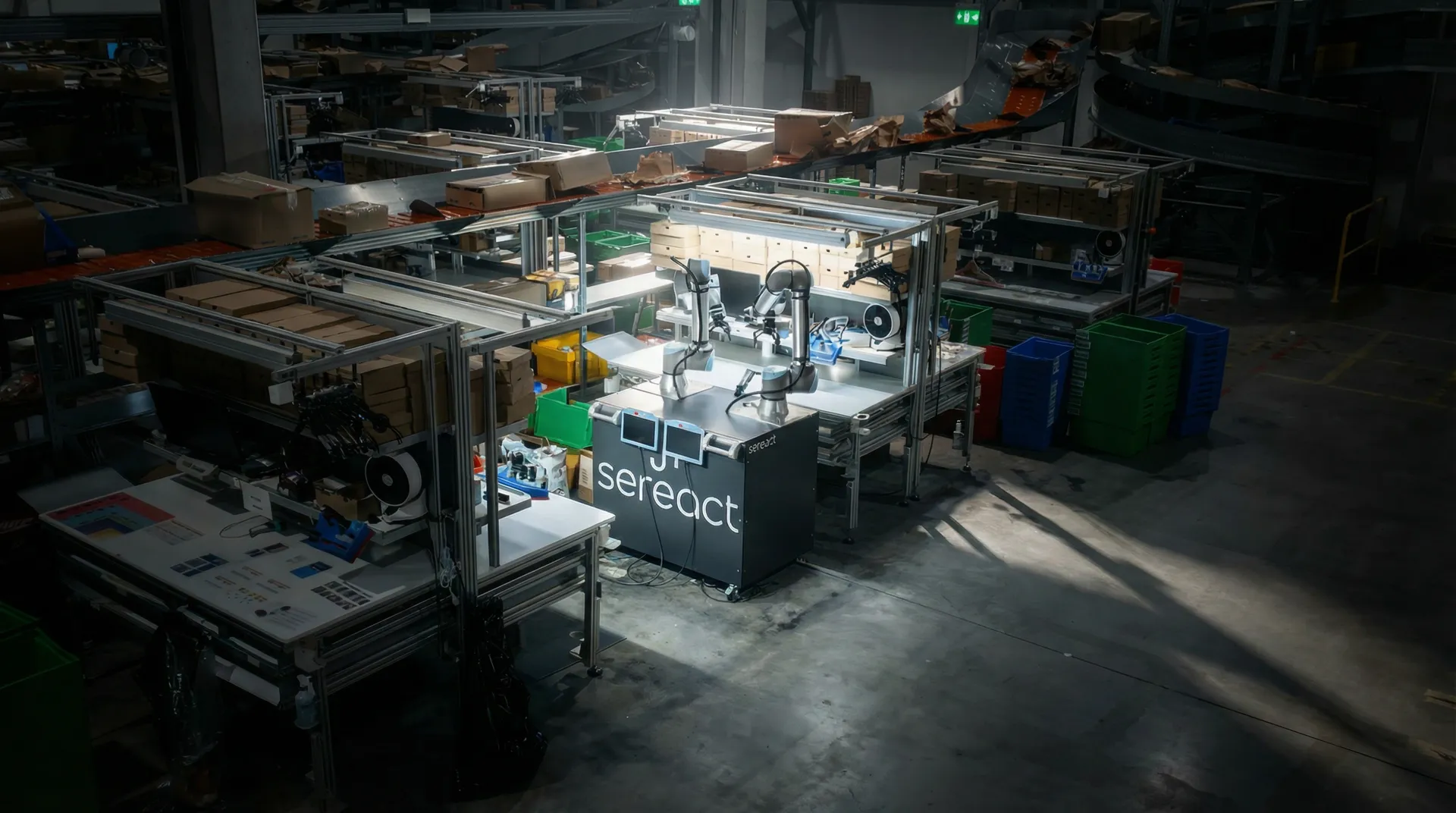
The station integrates into your existing environment with WMS connectivity, scanning infrastructure, and analytics through the Sereact platform, designed to scale by copy-pasting stations across your operation.
Why two arms, not one
Simpler warehouse tasks (single picks, place-to-tote) are already being automated by single-arm robots.
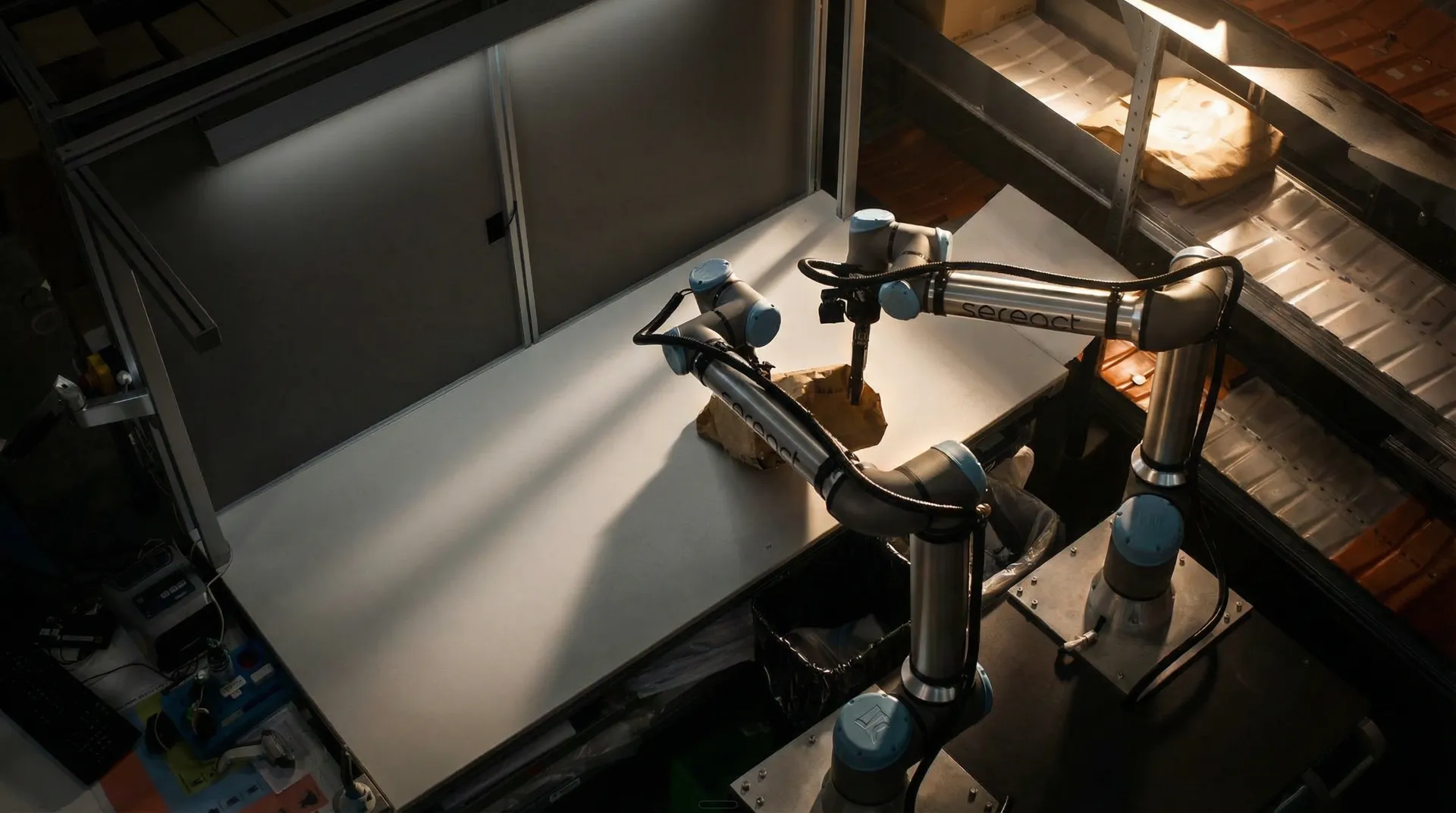
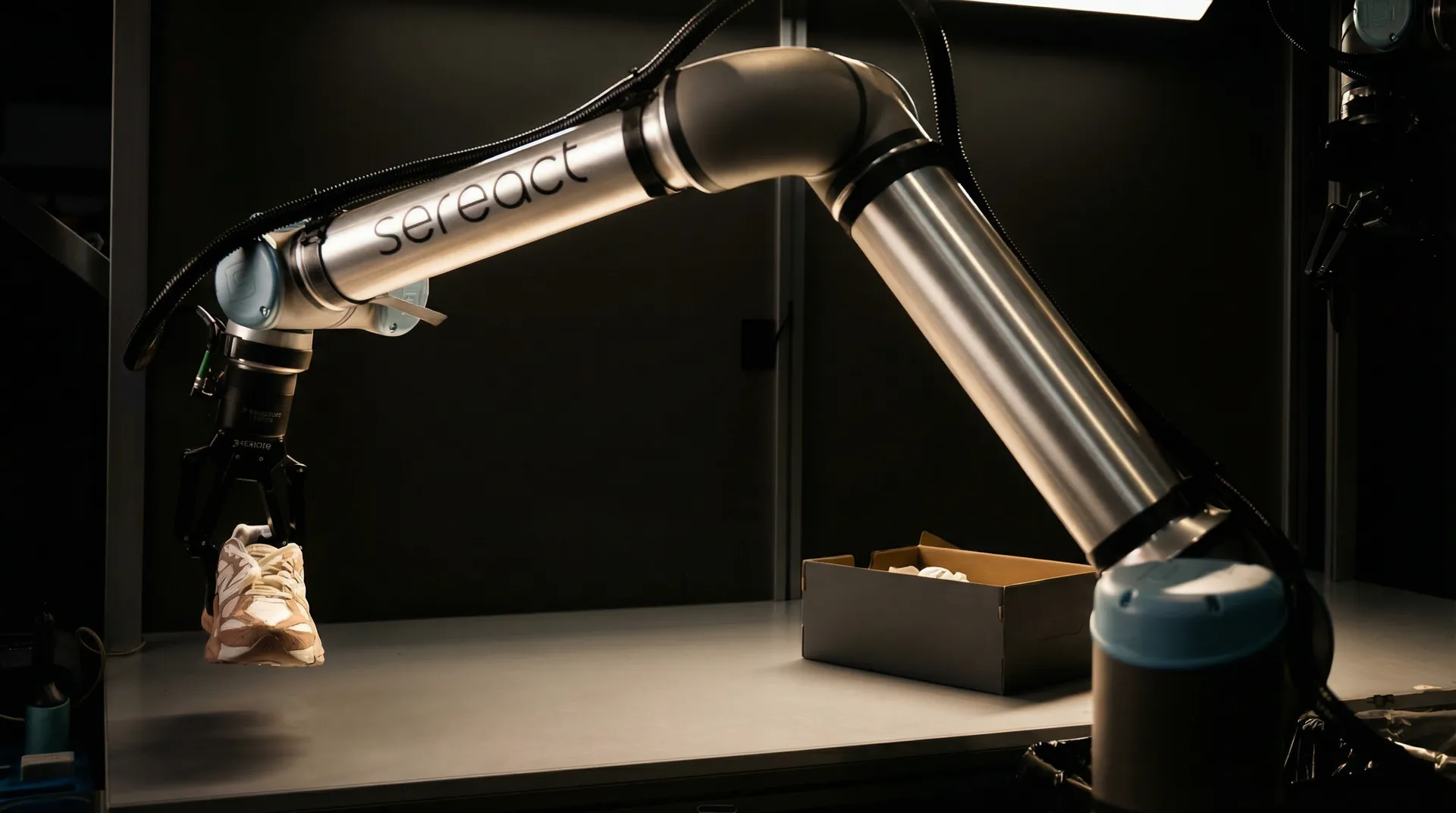
Returns are different. You need to hold a parcel open while reaching inside. Stabilise an item while scanning a barcode. Regrasp a polybag that's slipping. Fold a garment flat.
These are coordination tasks. They require two arms working together, with the dexterity to adapt mid-motion.
Sereact's dual-arm form factor mirrors human shoulders by design. The arms work in coordination: one holds, the other manipulates. When something shifts or slips, the system adjusts and recovers instead of aborting.
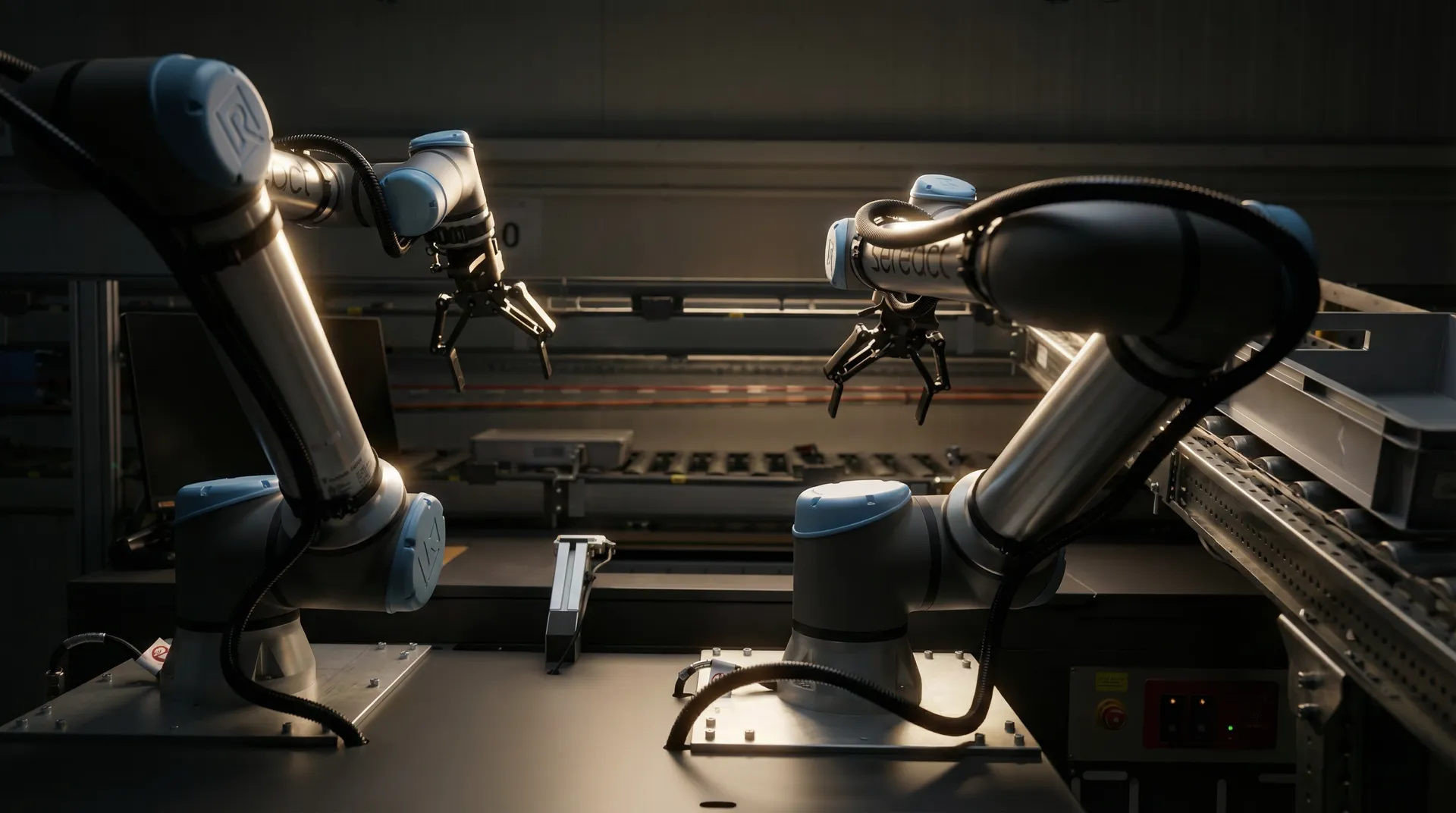
This is the difference between moving objects and actually handling returns.
Cortex.
The brain that learns on your floor
Most robotics models are trained in labs. They break in the real world.
Cortex is different. It is a Vision-Language-Action Model built to learn from live production, not staged demos.
After deployment, the system improves through a structured loop:
Data collection across tasks and sub-tasks specific to your operation
Continuous policy testing against real-world conditions
Edge case capture: recording recovery episodes for the hardest scenarios
Autonomous learning: the system explores, and reinforcement learning rewards better outcomes
This compounds over time. Performance doesn't plateau. It accelerates.
And because Cortex learns across Sereact's entire deployed fleet, every station benefits from what every other station has encountered. No other company has this feedback loop running in production today.
What this changes for your operation
Every return handled properly is a return that doesn't come back.
When items are inspected inconsistently, repackaged carelessly, or sorted into the wrong flow, they get shipped to the next customer in poor condition and returned again. That means double the last-mile cost, double the warehouse handling, and a damaged customer relationship.
The dual-arm station breaks this cycle:
Consistent inspection and sorting across every shift, every brand
Lower per-item handling cost, with OpEx savings from day one
Reduced rework: items processed correctly the first time don’t re-enter the returns loop
Fits into existing environments with minimal CapEx changes
Safer handling of unpleasant, soiled, or hazardous items
The result: lower COGS, higher resale rates, and better customer satisfaction downstream.
Built for production, not the lab
Every component is CE-certified. The station uses collaborative robot arms with safety fencing, deployed within your existing footprint.
The system is designed to work around your infrastructure:
Conveyors bring open parcels to the station
Pushers feed items from existing lines
WMS integration syncs decisions in real time
Humans stay in the loop for exceptions and edge cases
And because this is a generalized station, not a single-purpose machine, the same hardware can move from returns handling today to inbound processing or decanting tomorrow. One station, trained for multiple warehouse operations.
The robot handles the repetitive, error-prone, and unpleasant work.
Your team focuses on decisions.
Fleet intelligence, site-level control
Every Sereact station deployed anywhere feeds learnings back to the fleet. Cortex aggregates data across sites, shifts, and seasons to refine how the system inspects, manipulates, and recovers.
But nothing changes on your floor without validation. Improvements are rolled out deliberately. Each station runs within approved parameters. No experiments on your production line.
The result: your station gets smarter over time, without any disruption to your operation.
One station.
Multiple operations.
Returns handling is where this starts, but the station is built to do more.
The same dual-arm system, powered by Cortex, extends to:
Inbound processing and goods receipt
Decanting and replenishment
Kitting and recombination
Refurbishment workflows
Today you deploy it for returns. Tomorrow you reassign it to inbound. Same station. Same footprint. New task.
This is the first generalized robotic station for the warehouse: one that works like a skilled associate, moving between tasks instead of being locked to one.
Is this your operation?
This system is built for:
Fast-fashion and apparel warehouses with high return rates
3PLs processing returns for multiple brands under one roof
Manufacturers receiving defective components back from the field
Any operation where trained staff availability limits throughput
This is among the first deployments of Vision-Language-Action Model-powered robotics in live warehouse production. Fewer than five operations worldwide are running this today.
Bring it to your floor
Let us deploy a station on-site. See it handle your returns, in your environment, on your items.